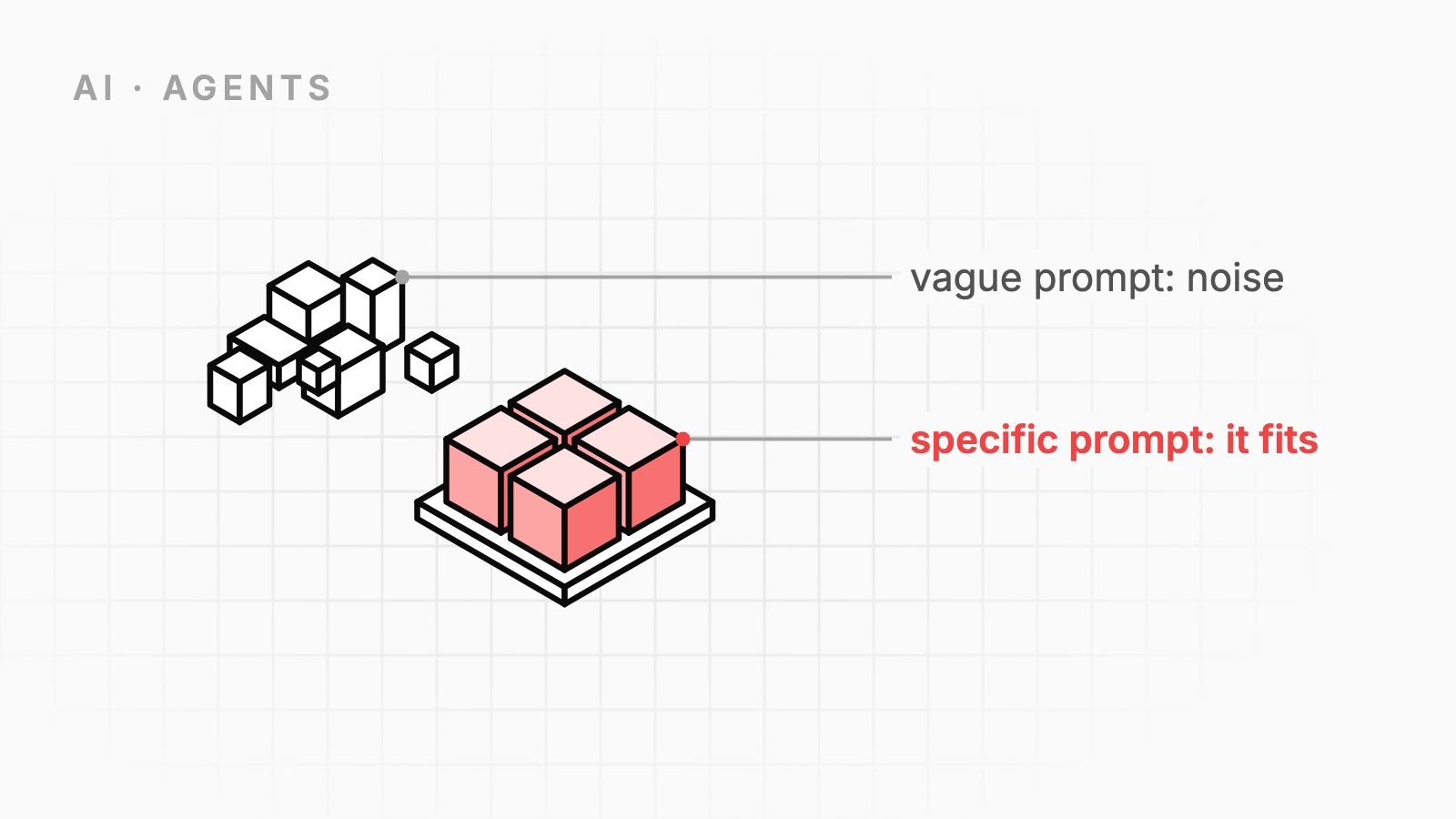

A lot of AI advice focuses on models, tools, and benchmarks.
That stuff matters. But in day-to-day work, the most underrated AI skill is much simpler: being specific.
The gap between a vague prompt and a precise one is often the gap between useful output and noise.
This shows up fast in engineering work. If you ask AI to help with a bug, you usually get generic guesses. If you describe the system, the failure, the constraints, and the goal, you start getting something you can actually use.
That is not because the model suddenly became smarter. It is because you gave it a problem it could solve.
Specificity is not fancy prompt writing
When people hear be specific, they often think it means writing long, complicated prompts.
That is not the point.
Specificity is just reducing ambiguity.
You are giving the model the information a competent teammate would need to do the work well on the first pass.
In practice, specificity usually means four things:
1. Context
What is this work happening inside?
This includes things like:
- what the system does
- what file or component matters
- what has already been tried
- what broke
- what surrounding code or business rules exist
Without context, the model fills in the blanks. Sometimes it guesses right. Often it does not.
If you say, write a retry function, the model has to invent the environment.
If you say, write a retry wrapper for a Node.js job that calls a rate-limited third-party API, retries only on 429 and 5xx, and logs the final failure, now it can aim.
2. Constraints
What should the model avoid?
Constraints are where most useful prompts get better.
This can include:
- do not change public APIs
- keep the solution small
- use TypeScript
- do not add dependencies
- preserve current logging style
- only touch files under
src/jobs - optimize for readability over cleverness
Constraints stop the model from solving the wrong problem in a technically correct way.
A lot of bad AI output is not wrong. It is just wrong for your codebase.
3. Format
What shape should the answer take?
This matters more than people think.
If you want a bug diagnosis, say that. If you want a patch, say that. If you want a step-by-step plan, say that. If you want a commit message, say that.
The less the model has to guess about the output format, the less cleanup you have to do.
A simple format request like return a markdown checklist or give me a diff-sized change, not a rewrite can save a lot of time.
4. Goal
What does success look like?
This is the part people skip most often.
The model needs to know the target, not just the task.
Improve this endpoint is vague. Reduce p95 latency on this endpoint without changing the response shape is clear.
One asks for random improvement. The other asks for a measurable outcome.
Goals help the model make tradeoffs the way you would.
What this looks like in real engineering work
Here are a few examples from normal engineering tasks.
Example 1: Debugging
Before:
Help me debug this test failure.
After:
A Jest integration test started failing after we moved auth checks into middleware. The failing case expects
403for a user without theadminrole, but it now returns302to/login. This is in a Next.js app using server-side auth cookies. Do not rewrite the auth system. I want the most likely root cause and the smallest fix.
Why the second one works better:
- it names the recent change
- it gives the expected and actual behavior
- it explains the stack
- it sets a constraint against over-solving
- it defines the desired output: likely cause and smallest fix
That is enough to get a focused answer instead of a list of generic test tips.
Example 2: Refactoring
Before:
Clean up this function.
After:
Refactor this TypeScript function for readability. Keep the same behavior and function signature. Do not introduce new helpers unless they are reused more than once. Prefer fewer branches and clearer naming over abstraction.
Why the second one works better:
- it states the language
- it protects behavior
- it limits unnecessary abstraction
- it tells the model what better means
Without that, clean up often turns into a style rewrite you did not ask for.
Example 3: Writing a query
Before:
Write a SQL query for active users.
After:
Write a Postgres query that returns users who signed in at least twice in the last 30 days, are not soft-deleted, and belong to accounts on the Pro plan. Return
user_id,last_sign_in_at, ordered by most recent sign-in.
Why the second one works better:
- it defines active
- it gives filtering rules
- it names the database
- it specifies the output shape
The first prompt leaves too much room for interpretation.
Example 4: Using an agent to make code changes
Before:
Update the docs for the new API behavior.
After:
Update the docs for the new
/v1/importsbehavior. The endpoint now returns202and ajob_idinstead of waiting for completion. Only update user-facing docs underdocs/api. Add one short example request and response. Do not touch internal architecture docs.
Why the second one works better:
- it identifies the exact change
- it scopes the files
- it defines what to add
- it defines what not to touch
This is the difference between a one-shot edit and a cleanup session.
Why this compounds in agent systems
Specificity matters even more when you move from one-off prompts to agent systems.
A single vague prompt wastes one response.
A vague instruction inside an agent loop creates repeated low-quality actions.
If an agent does not know the real goal, it may search the wrong files, edit the wrong layer, write tests for the wrong behavior, or produce output in the wrong format. Each step looks plausible on its own. But the errors stack.
That is why agent systems are less about magic autonomy and more about good problem framing.
Specificity compounds because it improves:
- tool choice
- search quality
- edit quality
- verification quality
- handoff quality between steps
If your agent knows the context, constraints, format, and goal, it can make better local decisions without constant correction.
If it does not, you become a cleanup layer.
That is the hidden tax of vague prompting. It is not just one bad answer. It is extra review, extra retries, and extra drift across the whole workflow.
A simple way to get better results
Before you send a prompt, do a quick check:
- What context is missing?
- What constraints matter?
- What output format do I want?
- What is the actual goal?
You do not need a template every time. You just need enough detail to remove the obvious ambiguity.
A good prompt does not try to sound smart.
It makes the job clear.
Final thought
The biggest jump in AI usefulness usually does not come from switching models.
It comes from asking better.
Being specific is not prompt engineering theater. It is basic operational clarity.
In engineering, clarity is leverage.
The same is true with AI.
If you want less noise and more useful output, start there.