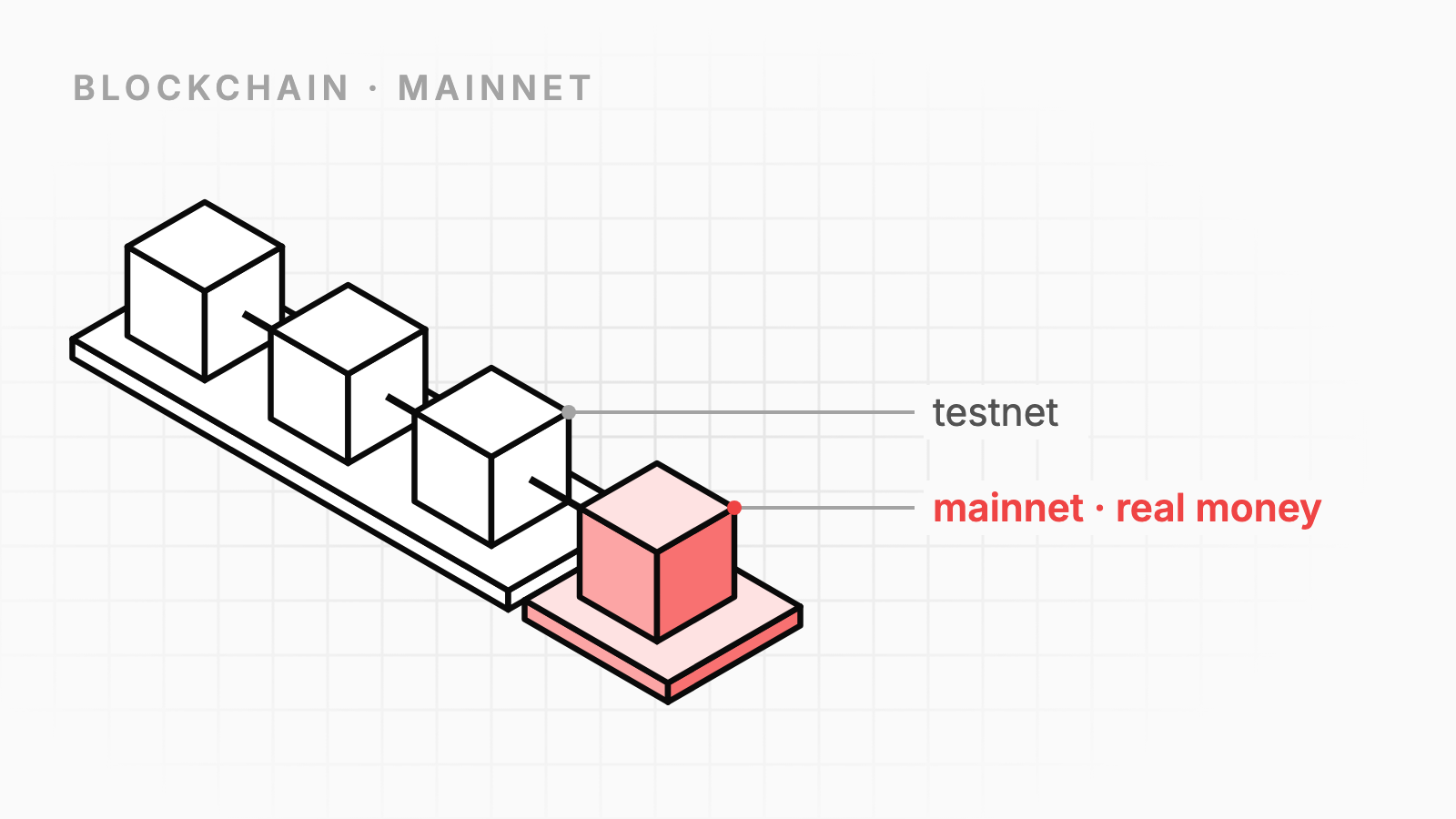

Shipping on testnet felt good.
The app worked. Transactions went through. Bugs showed up, but they were manageable. The system looked stable enough. I started to believe the hard part was almost done.
Then we went to mainnet.
The codebase did not magically break. The contracts did not suddenly stop working. What changed was the environment around the code. The stakes got real. Small inefficiencies mattered. Weak assumptions got exposed. User behavior changed fast.
This is the part that is easy to underestimate when you are building in public and testing hard. Testnet is useful, but it hides a lot. Mainnet does not.
The biggest change: failure starts to matter
On testnet, a failed transaction is annoying.
On mainnet, a failed transaction costs somebody money.
That one difference changes how you think about almost everything. A rough edge that feels acceptable in testing becomes a real product problem when users pay gas for it. A confusing button is no longer just bad UX. It can directly lead to wasted funds, repeat attempts, support load, and loss of trust.
Before mainnet, I mostly thought in terms of does this flow work?
After mainnet, I started thinking in terms of what happens when this flow works poorly, slowly, or only half works?
That pushed a lot of issues out of the nice to have bucket and into the critical bucket. Better validation mattered. Better transaction state handling mattered. Clearer messaging mattered. Guardrails mattered.
Mainnet makes you respect the cost of being wrong.
Latency assumptions stop being theoretical
On testnet, I had a mental model that was too clean.
I assumed network calls would be reasonably fast. I assumed transaction propagation would be consistent enough. I assumed confirmation timing would stay within a narrow range. I assumed retries were mostly harmless.
Those assumptions held often enough to feel true. They were not true.
On mainnet, latency is part of the product. Not just backend latency, but wallet interaction latency, RPC variance, indexing delay, block timing, confirmation delay, and every gap between those systems. Users feel all of it as one experience.
A transaction can be submitted and still feel invisible for too long. A read can return old data while the wallet already shows the transaction as sent. A background refresh can race with a confirmation. A flow that looked instant in local testing now has multiple waiting points and ambiguous states.
The lesson for me was simple: if a system crosses async boundaries, I need to design for those boundaries as first-class product states.
Not just loading. Real states. Pending wallet signature. Submitted to network. Included but not indexed. Confirmed but not reflected in derived UI yet. Retrying read. Recoverable failure. Final failure.
Mainnet made me stop treating time as a detail.
Gas costs turn product decisions into economic decisions
Gas was the easiest thing to ignore on testnet and one of the hardest things to ignore on mainnet.
On testnet, users click freely because the money is fake. On mainnet, every extra step has a price. Every avoidable write has a price. Every failed attempt has a price. Every poorly batched action has a price.
This changes both architecture and UX.
Some flows that looked fine in testing felt irresponsible on mainnet because they required too many transactions. Some contract interactions were technically correct but too expensive to feel reasonable. Some edge cases were rare, but when they happened, the fallback path was costly enough that it deserved redesign.
Gas cost planning is not only about contract optimization. It is also about flow design. How many signatures does this action require? Can two writes become one? Can work move offchain without breaking trust? Can users preview cost before they commit? Can the app avoid sending a transaction that is likely to revert?
Mainnet forced a more honest question: not can the user do this? but should the user have to pay this much to do this?
That question cut through a lot of engineering vanity.
User expectations change the moment real money is involved
Testnet users are generous.
They forgive incomplete polish. They tolerate resets. They accept weirdness because they know they are testing. They want to help. They understand that things break.
Mainnet users are not signing up to help. They are trying to get something done.
That means they bring a different standard. They want predictability. They want plain language. They want to know what happened, what it cost, and what to do next. They do not want to interpret internal system states or debug your product from the browser console.
I felt this most in areas where I had been too close to the implementation. There were messages that made sense to me because I knew the stack. They did not make sense to users. There were flows where I assumed intent because I knew the happy path. Users did not.
Mainnet made me write for people who did not care how the system worked, only whether it was safe and reliable enough to trust.
That was healthy. It pushed me toward clearer copy, fewer hidden assumptions, and less tolerance for hand-wavy product decisions.
Error handling becomes part of the core product
I used to think of error handling as a finishing pass.
Mainnet made it obvious that error handling is the product.
Not because errors happen constantly, but because when they do happen, the user is already in a high-friction moment. They may have signed something. They may have paid gas. They may be unsure whether trying again will fix the issue or make it worse.
Generic errors are especially bad here. Something went wrong is not neutral. It leaves the user holding risk.
The error handling that mattered most was not fancy. It was specific.
Tell the user whether the transaction was rejected in the wallet, failed onchain, or is still pending. Tell them whether funds are at risk. Tell them whether retrying is safe. Tell them when the UI may be behind the chain. Tell them what reference they can use to verify status themselves.
A lot of mainnet hardening was just replacing vague failure modes with precise ones.
That work does not look exciting in a changelog. It matters more than a surprising number of features.
Confidence on testnet can hide the wrong kind of confidence
The uncomfortable part of going mainnet was realizing that I had confused tested behavior with production readiness.
Testnet gave me confidence that the code could work.
Mainnet asked whether the whole system could survive reality: expensive mistakes, partial failure, timing drift, user stress, external dependency variance, and the fact that trust is easy to lose and slow to rebuild.
That does not mean testnet is misleading. It just means testnet is incomplete. It verifies mechanics. Mainnet exposes consequences.
Looking back, the shift was less about scaling traffic or changing architecture and more about changing standards. I became less impressed by green paths and more interested in bad paths. Less interested in whether a transaction succeeded eventually and more interested in whether the product made the whole experience legible.
What I would carry forward
If I were starting another project today, I would still use testnet heavily. But I would treat it as a narrow tool, not proof of readiness.
I would push harder on cost visibility earlier. I would design UI around delayed and partial state from day one. I would write better failure messages before launch, not after support requests. I would assume that every avoidable transaction is product debt. I would spend less time admiring that something works and more time asking what happens when it does not.
Going mainnet did not teach me that blockchain is hard. I already knew that.
It taught me that the real step up is not technical novelty. It is operational honesty.
On testnet, your project proves it can function.
On mainnet, it has to deserve trust.