Why I am thinking this way
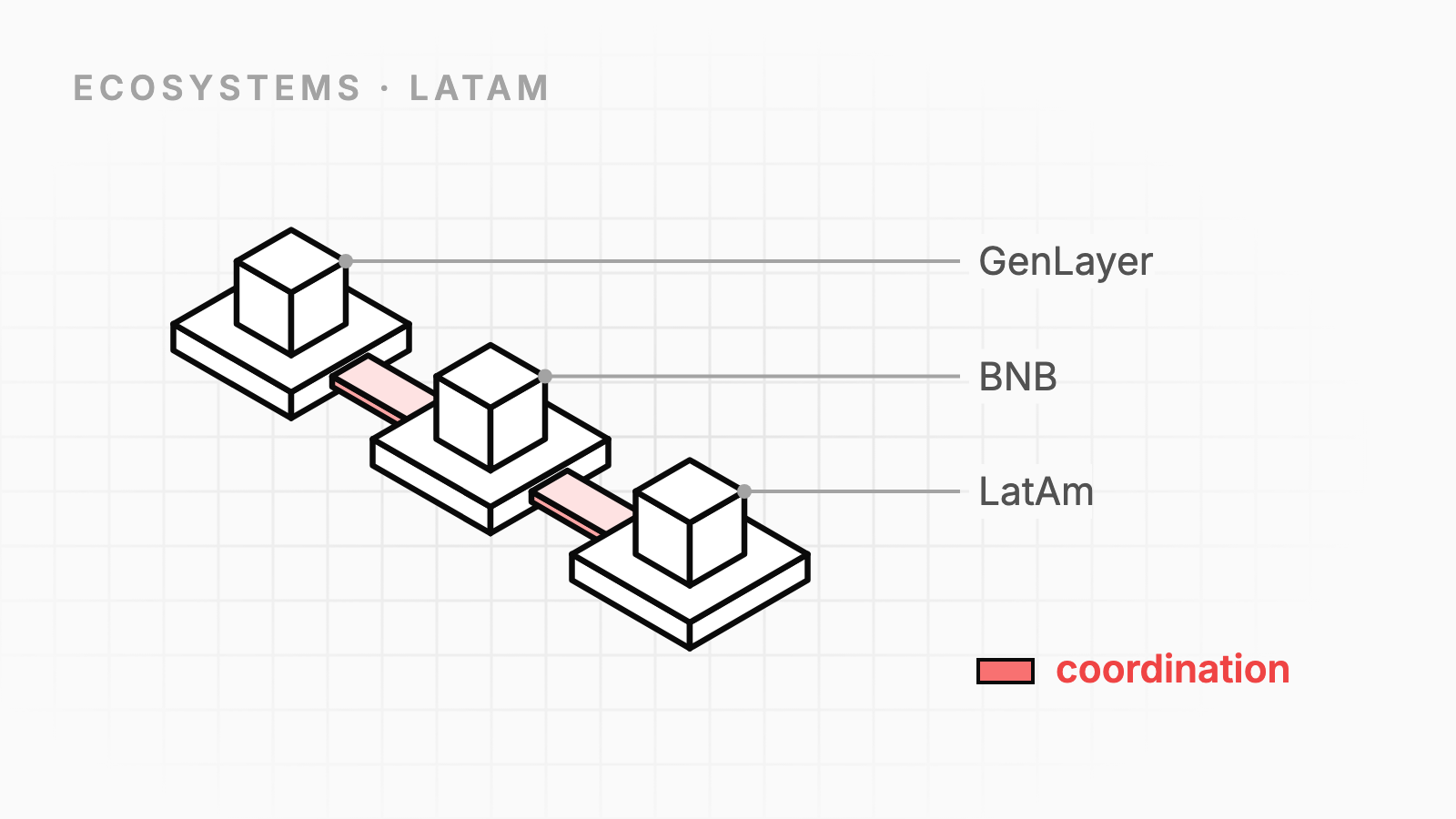
I have been spending more time around different crypto and builder communities at once: GenLayer, BNB, and people working across LatAm. That has changed how I think about building in public.
The simple version is this: building in one ecosystem is already hard. Building across several is harder, but it also creates a different kind of leverage.
Not the fake kind of leverage where you post everywhere and call it strategy.
I mean real leverage:
- more distribution paths
- more feedback loops
- more chances to find the right use case
- more ways to match product work with actual community needs
For a solo builder, this matters a lot. I do not have a giant team, a big budget, or infinite time. So if I am going to spend energy in public, I want that effort to travel well across communities instead of dying inside one local bubble.
That is the core idea behind building across ecosystems. It is not about being everywhere. It is about finding where overlap creates momentum.
What changes when you build across ecosystems
Each ecosystem has its own language, incentives, and social norms.
Some groups care a lot about infrastructure and technical originality. Some care more about users, growth, and market access. Some care about local trust, language, and whether people actually show up consistently.
If you ignore those differences, you look shallow very fast.
A multi-ecosystem strategy only works if you treat each community as real, not as a distribution channel to exploit.
That means a few practical things:
- listening before pitching
- learning what problems people already care about
- being clear about what is real versus what is still an idea
- showing work in a way that fits the context
- avoiding the habit of copy-pasting the same message everywhere
This is where building in public gets more useful. If I share openly while I am still learning, I get feedback earlier. I also make it easier for people from different ecosystems to see where their interests might connect.
That does not remove the complexity. It just makes it visible sooner.
Why the LatAm angle matters
The LatAm part is not cosmetic. It is not there to make the story sound global.
It matters because local context changes what people need, what they trust, and what they are willing to try.
A lot of crypto conversation still gets framed from a US or Europe-first lens. The assumptions behind that lens do not always hold in LatAm. Access, credibility, community ties, language, and economic reality all show up differently.
That creates real constraints, but it also creates real opportunity.
LatAm communities often have:
- stronger grassroots energy
- closer founder and builder relationships
- practical interest in tools that solve real problems
- openness to experimentation when it is paired with trust and follow-through
For me, that makes LatAm important in two ways.
First, it is a place where community work can still matter in a direct way. People remember who showed up, who helped, and who kept going after the initial excitement faded.
Second, it is a place where cross-ecosystem coordination can be more valuable than brand signaling. If you can connect the right people, ideas, and incentives, that can go further than a polished announcement.
The main point is simple: the LatAm angle matters because communities there are not just audiences. They can be strategic partners in shaping what gets built and how it spreads.
What a three-way collaboration could look like
One thing I have been thinking through is what a possible collaboration between Buildersclaw, GenLayer, and BNB LATAM could actually mean.
Right now, I do not think the value is in forcing a big formal structure too early.
The value is probably in creating a practical bridge.
Buildersclaw can help with builder energy, experimentation, and execution. GenLayer brings a distinct technical direction and a chance to explore new kinds of applications. BNB LATAM brings regional reach, community density, and local ecosystem relevance.
In theory, that is a strong combination.
But theory is cheap.
In practice, a three-way collaboration only works if each side gets something concrete:
- builders get support, visibility, and reasons to stay engaged
- ecosystems get real experiments, not surface-level marketing
- the local community gets opportunities that feel relevant, not imported
- organizers get a working rhythm that does not collapse under coordination overhead
That last point matters more than it sounds.
Three-way collaboration is not just three logos on one graphic. It means aligning timelines, expectations, communication style, and ownership. It means being clear on who is doing what. It means not assuming interest equals commitment.
As a solo engineer, this is the part I find both exciting and difficult. The upside is clear. The coordination cost is also clear.
What feels promising
A few things feel genuinely promising to me.
Shared builder programs
Hack sessions, workshops, office hours, and lightweight challenges could work well if they are designed around actual builder needs.
Not generic come build events.
I mean focused programs where people can learn, test ideas, and get direct feedback from people inside each ecosystem. That kind of format can create trust faster than broad promotion.
Cross-pollination of communities
There is real value in helping good people meet each other across network boundaries.
A GenLayer builder might benefit from BNB LATAM community reach. A LatAm founder might be curious about GenLayer but need a lower-friction entry point. Buildersclaw can help translate between the technical and community sides.
That translation layer is often missing. When it exists, things move faster.
Narrative with substance
There is also a strong story here if it stays grounded: builders from LatAm connecting with emerging technical ecosystems through practical collaboration.
That is a better story than hype because it can be backed by visible work:
- prototypes
- events
- feedback loops
- local participation
- clear follow-up
If the work is real, the narrative takes care of itself.
What still feels exploratory
A lot of this is still early, and I want to be honest about that.
The exact fit is not proven yet
Just because three groups can collaborate does not mean they should. There has to be a clear fit in goals, timing, and execution style.
That fit needs to be tested through small actions, not assumed in advance.
Attention is easy, consistency is hard
People are usually open to early conversations. The harder question is whether that turns into repeated action.
Can people keep showing up? Can organizers keep momentum? Can builders get enough value to stay engaged?
That is where many good ideas stall.
Coordination can become the whole project
This is a real risk. If too much energy goes into aligning everyone, the collaboration starts serving itself instead of producing useful outcomes.
For me, that is a warning sign. The structure should support the work, not replace it.
Local relevance has to stay real
If there is a LatAm angle, it has to show up in the actual design of the work. Language, community leadership, local partners, and follow-through all matter.
If those things are absent, then LatAm becomes branding instead of strategy.
How I am approaching it
My current approach is simple:
- stay close to real builders
- keep conversations concrete
- test small before scaling
- share openly, but do not oversell
- look for repeated signals, not one-off excitement
I am interested in the overlap between ecosystems because I think that is where new opportunities often start. But I do not want to pretend the overlap is enough by itself.
The promising part is real. So is the uncertainty.
That is probably the most honest way to say it.
Building in public across ecosystems is less about making noise and more about building bridges carefully. If Buildersclaw, GenLayer, and BNB LATAM can find a practical rhythm together, that could become something meaningful.
Not because it sounds impressive on paper.
Because it could give builders better paths, give communities stronger connections, and create work that actually travels across boundaries.