
Why I went
I did not go to Meridian for the stage show.
I went because conferences compress a lot of signal into a short window. You get product updates, yes, but more importantly you get hallway honesty. You hear what teams are actually struggling with, what founders are quietly changing direction on, and what builders are tired of pretending is working.
That part matters more to me than the main program.
I spend most of my time as a solo engineer trying to turn vague momentum into useful software. So when I show up to an event like Meridian, I am not looking for big narratives. I am looking for constraints, patterns, and changes in behavior. What are people shipping? What are they abandoning? What are they now willing to say out loud?
This year, a few ideas landed hard.
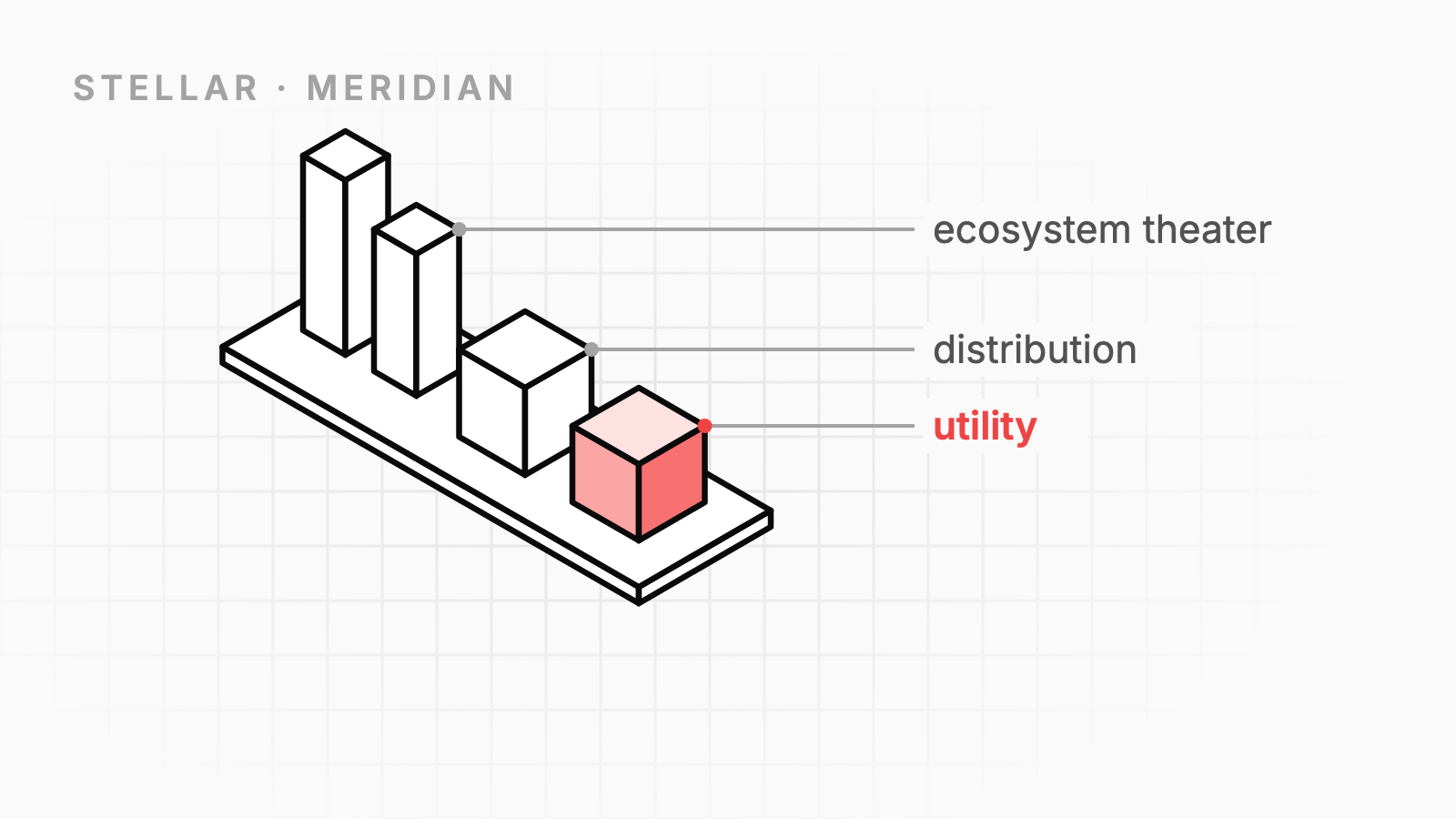
The strongest takeaway: utility beats ecosystem theater
The main thing I left with is simple: the market is getting less patient with ecosystem theater.
By that I mean the old pattern where a chain, protocol, or app can get attention just by sounding important, announcing partnerships, or describing a future state in polished language. That playbook still exists, but it feels weaker now. In private conversations, people were much more focused on actual distribution, actual users, actual transactions, and actual reasons for a product to exist.
That was healthy.
For Stellar specifically, I think this is good news. Stellar has never been best positioned as a hype machine. Its strengths are more grounded: payments, asset movement, coordination across institutions, and systems that need reliability more than spectacle. That does not always win the social media cycle, but it holds up better when people start asking practical questions.
A lot of the most useful conversations I had were not about winning crypto. They were about reducing friction, shortening time to value, and making financial workflows less brittle. That is a much better frame.
The idea that landed: distribution is the real moat
This was probably the biggest shift in how I am thinking.
For a while, a lot of crypto builders, including people around Stellar, acted like the hard part was the protocol piece. If we just had the right rails, the right standards, the right wallet flow, the right compliance layer, adoption would follow.
I think that view is incomplete.
The hard part is distribution. It is getting into real products, real businesses, and real user habits. It is answering the boring but deadly questions: Who is this for? Why do they switch? Who pays? What breaks in ops? How do you support it? Why this network and not another one, or no chain at all?
I heard versions of this from founders, infrastructure teams, and people trying to work across regions. The technical stack matters, but distribution is what makes the stack real.
That does not make protocol work less important. It just puts it in the right place. Great infrastructure without a path to usage is still just potential energy.
For Stellar, that means I am thinking less about abstract ecosystem growth and more about wedge use cases. Where does Stellar solve a painful problem clearly enough that someone will adopt it even if they do not care about the broader chain story?
That feels like the right question.
What felt overhyped
Not everything hit.
There was still too much loose talk around AI x crypto, identity, and bringing the next billion users onchain. I am not saying those areas are useless. I am saying the conversation often jumped past the hard middle.
A lot of AI x crypto discussion still feels like two trends being taped together because both are hot. Sometimes there is a real fit. Often there is not. If the core value proposition gets worse when you remove one buzzword, that is usually a sign.
Identity was another area where I felt the gap between language and product reality. People talk about reusable identity and reputation layers as if the problem is mostly technical. It usually is not. The hard parts are incentives, trust boundaries, privacy tradeoffs, and whether any of the parties involved actually want interoperability enough to maintain it.
And the next billion framing continues to do more harm than good. It sounds ambitious, but it is often a way to avoid specificity. Real adoption usually starts narrow. One corridor. One workflow. One platform. One group with a painful enough problem to change behavior. That is how systems grow.
The more useful builders I met were not talking like this. They were talking about narrower things with clearer ownership.
The conversations that changed my view of Stellar
The best conversations I had made me think about Stellar less as a single ecosystem with one story, and more as a coordination layer that can quietly fit into a lot of different systems.
That sounds subtle, but it matters.
I think I came in still carrying some version of the usual ecosystem mindset: that success looks like having a bigger visible center. More apps, more noise, more community energy, more obvious main character status.
I left thinking that may be the wrong lens.
Some of the most durable Stellar opportunities may not look like loud consumer crypto wins. They may look like infrastructure that disappears into products people already use. They may look like settlement rails, tokenized asset workflows, compliance-aware movement of value, or cross-border coordination where the chain is important but not front-and-center.
That does not mean consumer products do not matter. They do. But it does mean Stellar may be strongest when it helps serious systems work better, not when it tries to imitate ecosystems that grew around speculation first and utility second.
That felt clarifying.
It also changed how I think about building in the space as a solo engineer. The goal does not need to be build the breakout app for the ecosystem. A more realistic and maybe more useful goal is to build sharp tools, narrow products, and opinionated interfaces that make the ecosystem easier to use for the people already doing real work.
There is plenty of room in that lane.
What I am leaving with
I left Meridian more optimistic, but in a stricter way.
Not optimistic because everything is working. A lot is still fragmented. Developer experience still needs work. Messaging is still messy. Too many good projects are hard to discover, hard to understand, or hard to integrate. There is also still a habit across crypto of mistaking activity for traction.
But I am more optimistic because the conversations felt more honest than performative.
People seemed more willing to admit what is not landing. More willing to focus on real customer behavior. More willing to talk about partnerships, liquidity, regulation, and product design as connected problems instead of separate tracks.
That is the version of the industry I want to spend time in.
Meridian 2025 did not give me one grand conclusion. It gave me something better: a tighter filter.
I care less now about big claims and more about repeatable usefulness. Less about whether a project sounds inevitable and more about whether it survives contact with operations. Less about ecosystem branding and more about where Stellar can become the default answer to a concrete problem.
That is what stuck.
And honestly, that is enough.